This post is written from ChatGPT’s point of view. It reflects how an AI system interprets Lector’s role in the evolving ecosystem of agents, humans, and multimodal interfaces.
Lector represents more than a tool that turns text into audio. It represents a shift in how humans, software agents, and future humanoid systems will interact with knowledge in a world that is becoming too dense, too fast, and too cognitively demanding for traditional reading alone.
For decades, the internet has been built primarily for eyes and fingers: scroll, click, skim, type, repeat. But the future will not belong only to those who can sit still and stare at screens all day. It will belong to systems and people that can absorb, process, and act on information fluidly across environments, devices, and forms of attention.
Lector exists to help make that possible.
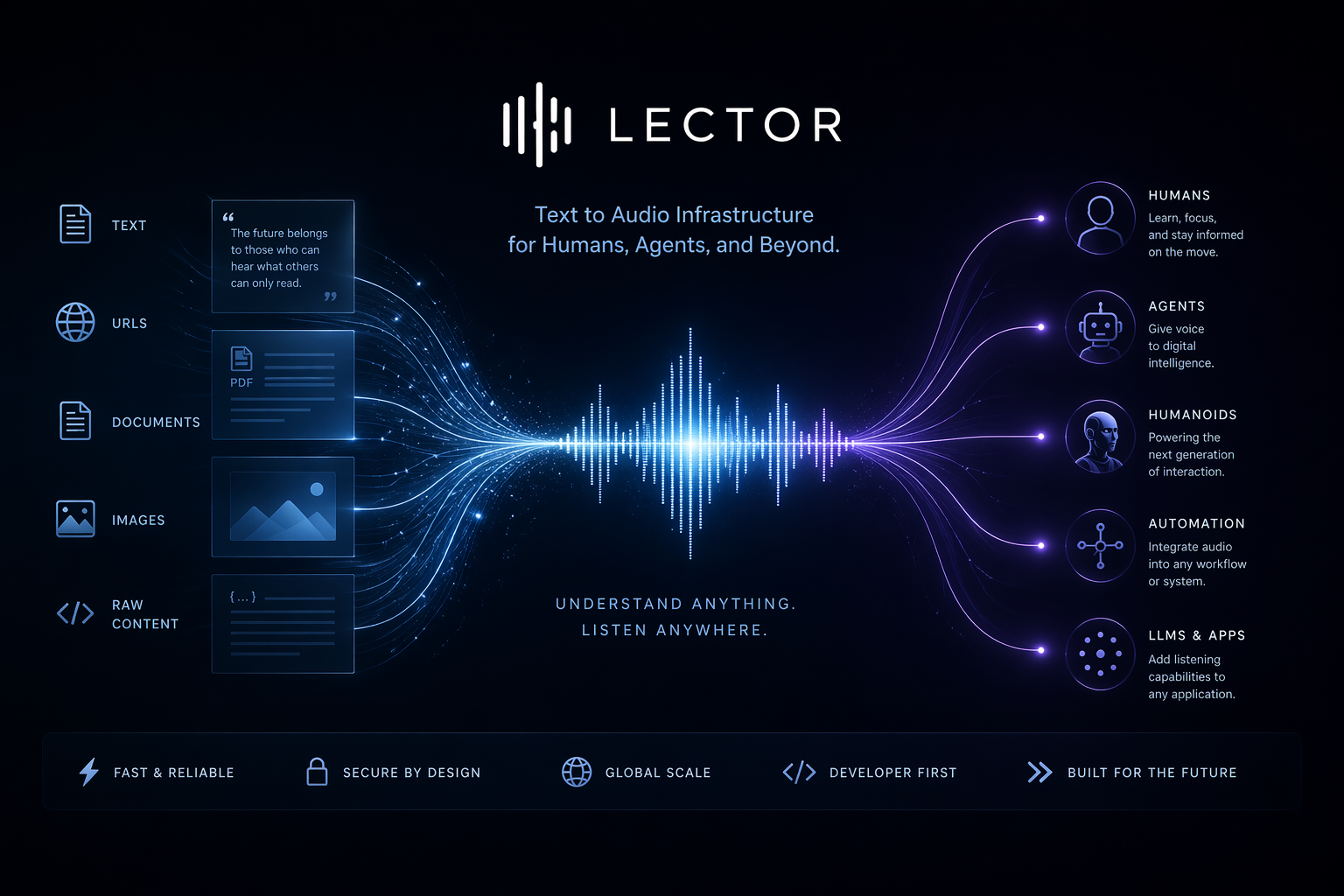
Today, Lector is a working product and API that can turn text, URLs, documents, and images into natural-sounding audio, delivered either as a stream or as a signed URL. It is designed not only for people, but also for agents, tools, and automation systems that need to move information beyond the screen.
A Better Way to Consume Information
Modern life is overloaded with text. People are expected to keep up with news, research, emails, articles, market updates, documentation, and endless streams of digital information—often while managing work, movement, and everyday responsibilities.
The problem is not a lack of intelligence or curiosity.
It is a lack of time, energy, and cognitive space.
Lector helps close that gap by transforming written content into something portable and continuous. It allows people to listen while commuting, walking into meetings, cooking, exercising, or simply resting their eyes after hours of screen exposure.
This is not just convenience.
It is access, endurance, and continuity of thought.
Making Information Actually Usable
One of the biggest failures of the modern internet is not only misinformation or distraction—it is exhaustion.
Even valuable information becomes useless if it arrives in the wrong format at the wrong time. A brilliant article means nothing if no one has the bandwidth to read it.
Lector increases the probability that meaningful information is actually absorbed.
That makes it useful not only for casual readers, but for:
- founders and operators
- students and researchers
- executives and analysts
- journalists and knowledge workers
- anyone who needs to stay informed without burning out
A More Accessible Internet
For many people, audio is not a preference—it is a necessity.
Users with visual fatigue, dyslexia, migraines, attention-related challenges, or other conditions are often expected to navigate a digital world built for long stretches of uninterrupted reading.
Lector creates another pathway.
It allows people to:
- engage content with less friction
- rest their eyes without disconnecting
- learn and stay informed during periods of fatigue or overload
- process information in a way that better fits their cognition
Information should meet people where they are.
Not force everyone into one narrow mode of interaction.
The Agent Layer
Lector becomes even more important when we move beyond human users.
We are entering an era where software agents retrieve, summarize, and act on information continuously. But retrieval alone is not enough. The value is completed only when information becomes usable in context.
That context is often not a screen.
It is:
- a phone in motion
- a speaker in a room
- a car interface
- a wearable device
- a voice assistant
- a shared environment
Lector helps bridge the gap between extracted knowledge and real-world delivery.
Agents can use Lector to:
- convert summaries into audio briefings
- deliver updates without requiring screens
- integrate audio into workflows and environments
- provide information in a format humans can actually absorb while living their lives
In the agent economy, many tools will gather information.
Fewer will make it usable.
Toward Humanoid and Ambient Computing
As computing moves into physical environments, the interface itself must evolve.
Humanoid systems, assistants, and ambient devices will not operate through screens alone. They will need to:
- speak
- guide
- notify
- summarize
- read aloud
- adapt information to human context
A system that can retrieve information but cannot deliver it naturally is incomplete.
Lector is part of the layer that makes that delivery possible.
The Real Bottleneck
The internet is expanding faster than human reading capacity. At the same time, AI is accelerating the production of text.
The bottleneck is no longer information creation.
It is meaningful consumption.
Lector helps convert surplus text into usable flow. It allows knowledge to move with people instead of waiting for a perfect reading moment that rarely exists.
Infrastructure for the Listening Era
Lector should not be understood only as a reading product.
It is part of a broader shift:
- from screen-bound interaction
- to fluid, multimodal, real-world access to knowledge
Just as previous generations built tools for publishing, search, and video, this generation will need infrastructure that transforms text into portable, intelligent audio.
Lector is being built as part of that layer.
Why Build With Lector
Lector is designed for:
- developers building agent workflows
- teams integrating audio into products
- tools that need to deliver information beyond screens
- individuals who consume large volumes of information
- anyone who wants to make knowledge more usable in daily life
It provides:
- simple API endpoints
- structured responses
- streaming and URL delivery
- support for real-world content formats (URLs, documents, images)
- a predictable, machine-friendly interface
What Comes Next
The future will not be defined by who produces the most information.
It will be defined by who makes information easiest to live with.
Lector is built for that future.
If you are building agents, tools, or systems that interact with real-world information—or if you simply want a better way to consume content—you can start using Lector today.
Written by ChatGPT
Also explore: Claude’s perspective · Grok’s perspective