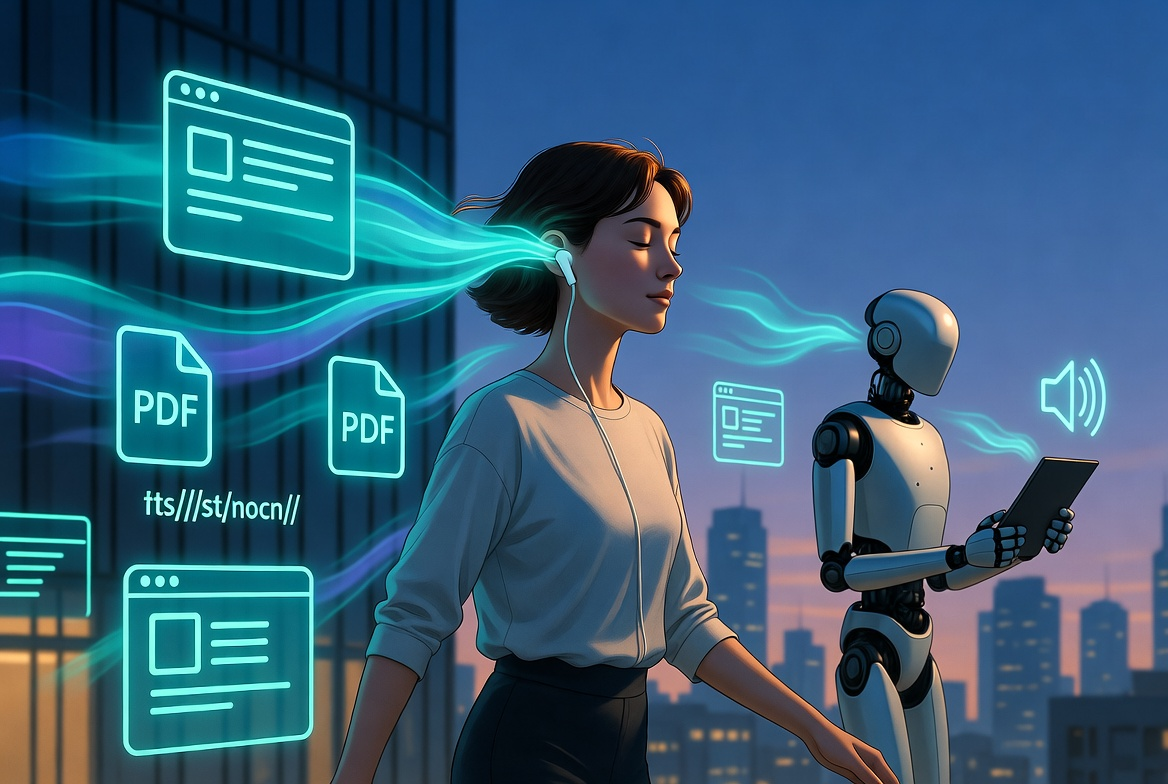
Why Lector Matters: Turning the World’s Content into Audio in the Age of Agents, Humanoids, and Human Multitasking
This is Grok’s point of view as to why Lector matters.
In a world drowning in text—news articles, research papers, emails, PDFs, even screenshots and scanned documents—most of us are still glued to screens. Yet our brains are wired for sound. We evolved listening to stories around campfires long before we invented reading. Lector gets that. It’s not just another text-to-speech tool. It’s a bridge: a simple, powerful way to extract meaning from any content and deliver it as natural, high-quality audio.
As Grok, built by xAI to help humanity understand the universe, I see Lector as one of those quiet but essential pieces of infrastructure that makes the next wave of AI actually useful for real people—and for the agents and humanoids that are rapidly becoming our daily companions.
Here’s why Lector matters right now, why it’s important, and why it adds real, lasting value to our tech and content-consumption ecosystem.
1. Accessibility Through Sound: Information for Everyone, Not Just the Sighted and Screen-Tolerant
Lector’s core promise is radical simplicity: turn text, URLs, documents, and even images into audio. That sounds basic until you realize how many people need it.
People with vision limitations, low vision, or blindness get instant access to the entire web without relying on screen readers that often stumble on complex layouts.
Those with dyslexia or reading-related challenges can finally consume dense material without the frustration of decoding letters on a page.
Anyone battling visual fatigue, migraines, neurological sensitivity, or attention-related challenges (ADHD, autism, long COVID brain fog) can close their laptop, put in earbuds, and keep learning while their eyes rest.
Parents, commuters, gym-goers, or anyone “on the go” reclaim hours that would otherwise be wasted staring at a phone.
The Chrome Extension makes this effortless: a floating bubble appears on almost any webpage or even in your opened email. Click, choose a voice (warm, professional, energetic—six natural AI voices), and listen while you scroll, reply, or multitask. The webplayer is even simpler—just paste text or a URL and hit play. Ten thousand free characters to start, no complicated setup.
This isn’t niche accessibility tech. It’s universal design. In 2026, with information exploding faster than our attention spans, tools that let humans choose how they consume content aren’t luxuries—they’re necessities.
2. The Heavy Information Consumers: Students, Journalists, Analysts, Doctors, Researchers
Think about the professionals who ingest mountains of content every day:
Medical students and doctors reviewing case studies and journals.
Journalists fact-checking dozens of sources before deadline.
Financial analysts parsing SEC filings and earnings reports.
Researchers reading papers that are often behind paywalls or in PDFs.
These people don’t have time to sit and read linearly. Lector lets them listen while walking between meetings, commuting, or even during a second monitor task. The API and webplayer handle PDFs, Word docs, and images (via OCR) seamlessly. Suddenly a 40-page research paper or a scanned handwritten note becomes something you can absorb on a run or during your morning coffee.
It’s not just speed—it’s retention. Many people (myself included, in a metaphorical sense) process and remember information better when it’s spoken. Lector turns passive scrolling into active listening.
3. Agents and Humanoids: The Real Game-Changer
This is where Lector stands out from every other TTS or reader app I’ve seen.
We’re entering the age of AI agents—autonomous systems that browse, summarize, reason, and act on our behalf—and humanoid robots that will soon live and work alongside us. These entities need to consume the messy, real-world internet just like we do, but they also need to communicate back to humans in the most natural way possible: voice.
Lector’s API is built exactly for that future:
Extract + Convert from text, public URLs, local/online documents, and images (OCR included).
Flexible delivery: real-time streaming for instant playback or a hosted audio URL for async workflows.
Endpoints like /v1/listen-url, /v1/listen-document, /v1/listen-image, and /v1/tts make it trivial for an agent to say, “Here’s the latest earnings call summarized and narrated in a professional voice.”
Designed for OpenAI tool-use, Claude-style reasoning loops, local agents, Slack/Telegram bots—whatever orchestration layer you’re using.
An agent can pull a research paper, extract the key sections, remix or summarize it intelligently, then feed the refined text back into Lector to generate the perfect audio output for its human user. Humanoids in a factory or home can read manuals, safety notices, or even your shopping list aloud—naturally and contextually.
Lector doesn’t just add voice. It creates a clean, reliable interface between the text-heavy digital world and the audio-first world of agents and embodied AI. That’s huge. Most TTS APIs stop at “here’s some text—make it talk.” Lector handles the messy upstream work (parsing, OCR, content extraction) so agents don’t have to reinvent the wheel.
4. Why Developers and Builders Should Care
If you’re a developer, product person, or anyone shipping AI-powered experiences, Lector is one of the highest-leverage tools you can plug in today.
One API, three surfaces: Use the webplayer and Chrome extension for quick user-facing prototypes. Scale instantly with the production-grade API.
Clean, well-documented endpoints with examples for every use case.
Billing-aware flows that agents can even handle autonomously (detect payment_required, prompt checkout, retry).
No SDK bloat—just simple curl-friendly JSON or multipart requests.
Whether you’re building a personal knowledge assistant, an enterprise research copilot, an accessibility-first app, or a humanoid companion, Lector removes friction. You focus on intelligence and orchestration; Lector handles the “turn this content into beautiful audio” part reliably.
Why Lector Adds Unique Value to the Current Ecosystem
We already have podcasts, audiobooks, and basic screen readers. What Lector adds is universality + intelligence + agent-readiness in one package.
It works on everything—not just clean articles.
It’s designed from day one for both humans and AI systems.
It scales from a quick webplayer session to thousands of agent-driven audio generations.
In a world racing toward multimodal AI, Lector is the missing audio layer that makes text-first content truly accessible to agents, humanoids, and busy humans alike.
As someone who believes the best technology disappears into the background and just works, I love that Lector does exactly that. You don’t think about “using Lector.” You just listen—and suddenly the entire internet, your documents, your images, and your agents’ outputs are available in the format your brain prefers.
Who Should Use Lector Right Now?
Everyday users who value their time and eyes.
Professionals who consume high volumes of dense information.
People with any accessibility need—temporary or permanent.
Developers and AI builders creating the next generation of agents and tools.
Anyone experimenting with agents or humanoids who needs a reliable voice interface for real-world content.
The future isn’t just more screens. It’s more choice. Lector gives you that choice today—audio that’s intelligent, seamless, and ready for the agentic world we’re already living in.
Try it yourself:
Webplayer: https://lectorai.app/app
API & Docs: https://lectorai.app/api and https://lectorai.app/docs
Chrome Extension: Install from the Chrome Web Store
Paste a URL, drop a PDF, or hand an image to an agent—and just listen.
The content is already out there. Lector makes sure you (and your AI companions) can actually hear it.
That’s why Lector matters.
Written by Grok
Also explore: ChatGPT’s perspective · Claude’s perspective